
On-Demand Handyman App Development: Features & Business Strategy
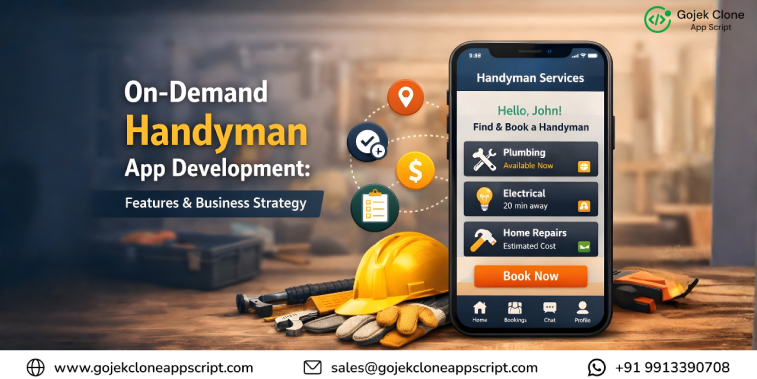
The on-demand handyman app space is filling out as more and more people turn to mobile solutions to get things done around the house. This comprehensive and practical guide is perfect for any bootstrapping entrepreneur, startup founder, or business owner who wants to tap into this market by building their own handyman service platform.
A well-planned one in all aspects would be necessary to build a successful on-demand handyman app. You’ll need to know what features customers will demand and how much it costs to develop those features, and also what business strategy makes sense in a crowded space.
In this post, we want to concentrate on such basic blocks of a handyman app design and development as must-have features for customers and handymen, or technical solutions that affect the cost. We’ll also dig into the revenue models that work for successful marketplace platforms and how to market your platform so you can attract customers and reliable pros.
Understanding the On-Demand Handyman App
Market size and growth projections for home services apps
The on-demand home services sector has also grown significantly and is projected to reach $89bn in total market spend this year and grow to $158bn by 2028. This means a CAGR (compound annual growth rate) of 12.1%, stimulated by people living busy lives and the rise of smartphones. Now, 65% of service requests are booked via the mobile app. Bookings on the phone dropped to a mere 20%. Smart home interoperability and IoT devices are opening up new service opportunities, while preventive maintenance apps have a 40% higher retention rate than reactive booking platforms.
Consumer behaviour shifts toward digital service booking
Current customers demand a quick and easy online booking service. Studies demonstrate that 78% of homeowners would rather book a repair via an app as opposed to on the phone, appreciating real-time tracking, upfront pricing, and verified provider profiles. Driving the change are millennials and members of Generation Z, 84% of whom had used mobile apps for home services in the last year. The most popular reservation block times are Lunch and Dinner. Should introduce a 24/7 digital sign-up, and should be an email OTP verification time clock for each dining slot. Option to update bookings, which cannot be cancelled or modified once secured. With 92% of people being affected by reviews and ratings, reputation management is key.
Competitive landscape analysis of existing handyman platforms
TaskRabbit owns the gig-economy model in urban areas; Handy specialises in repeat service and subscription packages. Thumbtack differentiates itself by focusing on lead-generation and professional networking opportunities. Companies in the regions, such as Angie’s List, leverage local market expertise and established contractor bases. When Amazon Home Services launched, it brought price pressure but not quality control issues. Successful platforms are either about broad categories of tasks or really specific, things like plumbing or electrical and things like that: that’s where they focus.
Key success factors driving app adoption
In-built user confidence with thorough selling vetting, insurance validation, and transparent pricing. Leading apps are able to sustain provider quality by making onboarding strict, offering ongoing training programs, and performance monitoring tools. Fast reactions are what count the most—platforms that respond in under an hour have 3x higher conversion rates. Geographical coverage density brings uniform quality of service availability, and a flexible schedule provides for emergency as well as scheduled maintenance. Payment systems, insurance claims, and smart home platforms add sticky user experiences to increase repeat bookings and lifetime value.
Essential Features for Customer-Facing App
Service category browsing and selection interface
A well-designed category UI is the gateway to your app’s success. Also, users want to navigate easily through a few categories of services, such as plumbing, electrician, carpentry and home repair. Visual icons, concise descriptions, and filtering features all make it easy for shoppers to find what they’re looking for. Categorizing with subcategories keeps things from getting too overwhelming, and the search is extensive, making sure users find exactly what they are looking for without adding any hassle.
Real-time handyman availability and booking system
A single source of real-time availability: Real-time changes everything from hunting and pecking to knowing for sure a property is available. Real-time scheduling displays open time slots immediately to avoid double-booking and customer frustration. Users are matched based on GPS, eliminating wait time and the need to travel. Automated alerts ensure everyone is in the loop for booking confirmations, changes, or cancellations. During peak times, the system must degrade gracefully and keep consistent availability information for all handymen in the pool.
In-app communication and progress tracking tools
Effective communication closes the divide between what your customer expects and what is provided. Messaging is integrated, and no personally identifiable information or phone numbers are exchanged, so you have secure and anonymous text messaging for quick follow-up. Photo-sharing functions allow end-users to show a problem and handymen to attach work progress. Real-time updates: Keep customers informed of arrival time, job stages and estimated completion times. “Push notifications help guarantee that no important messages are missed, leaving the user with a high level of transparency during each interaction.
Secure payment processing and digital receipts
Trust starts with secure transactions. Different customers have different needs, and various payment methods, such as credit cards, digital wallets, and buy now pay later providers, service these. All financial information is encrypted, and your data is PCI compliant, the industry standard. The product also automatically produces a receipt for clients with the categories of services, materials, and labor expenses. Tipping is made even simpler with additional tipping. Real-time pricing banners change all the time, so people know how much it is before they sign up, which not only helps reduce customer confusion and shock at billing, but builds trust that you are an open, honest platform.
Core Features for Handyman Provider App
Profile creation and skill certification management
A picture-based resume. There are a couple of apps (including one for Windows 8) that claim to create these in 3D, but I would like specific input from someone with real-world experience with a program that may actually make something successful. The professional should be able to upload certificates of skill, photos of portfolios, and reviews from clients on the app while there will be a verification process for qualifications. Intelligent categorization assists in pairing providers with job requests of their special trade skills.
Job request notifications and acceptance workflow
Providers also receive live push notifications for new jobs in their service area. The acceptance process might want to include details of the job, customer location, estimated time on site, and payment. Providers have the opportunity to either accept or decline a request in a given time frame and will be automatically reassigned to other providers that meet clients’ needs if no response is received.
Route optimization and navigation integration
Integrated GPS with route optimisation helps providers get from job to job faster. The optimal routes should be known according to traffic and priority of the work, and may include appointments. Third-party mapping enables turn-by-turn navigation, time-to-arrival estimates, and automatic customer notifications of provider location and imminent arrival.
Earnings tracking and payout management
The app contains a helpful earnings dashboard that easily details jobs done, payment, and total earnings. Service pros can receive reports and daily, weekly, and monthly earnings with detailed information by service fees, tips, and platform commissions. Tips are also flexible; professionals can instantly transfer the money, make weekly direct deposits or opt for a digital wallet so they can manage cash flow.
Advanced Features That Drive User Engagement
AI-powered service recommendations and pricing
Smart algorithms analyze the user’s input behavior, location-determined data, and service history to proactively recommend a handyman even before you know that you need one. Machine learning models devour thousands of data points—like seasonal trends, the age of a property, or past bookings—to predict when maintenance is due. Pricing algorithms schedule prices as a function of demand, provider availability, and job difficulty for competitively priced and the highest provider home earnings during surge hours.
Photo documentation and before-and-after galleries
They say a picture is worth 100 words, and nothing builds customer confidence and loyalty like good quality repeat bookings. The included camera has time-saving photo templates, so elevation study documentation can be professionally recorded throughout the project. What clients get in return are timestamped galleries that reflect progress on work, while providers build up amazing portfolios demonstrating their craftsmanship.
Multi-language support and accessibility options
Eliminating language barriers means entering new customer markets, and the market potential is huge. The text-to-speech feature, screen reader integration, and font-size control make handyman services available for users with disabilities, those who are visually impaired, or anyone else who prefers to have a website read aloud. Live translation means both users and provers can connect equally easily, while a fully localisable interface with data customisation means it works in the appropriate language with relevant data inputs.
Technical Architecture and Development Considerations
Backend Infrastructure Requirements for Scalability
To support thousands of leveraged users, all your handyman app needs is a backend that won’t even blink. It’s a cloud-based service, similar to AWS or Google Cloud Platform, that can scale in and out based on the server’s requests. Microservices architecture plays the best role here- you need to split your app into small, independent services of user management, booking systems, payment processing, and notifications.
This will provide you with the opportunity to easily scale different parts of it and allow for easier post-launch maintenance. Think about the use of load balancers and CDNs to distribute the traffic equally or to deliver static content more quickly. If using a caching service such as Redis, you can also reduce response times by caching the information in memory. And of course, remember to also use a database read copy for large query loads, not affecting your main database performance.
Database Design for Handling Multiple User Types
Such consideration forces you to consider your underlying database schema when doing operations on both customers and handymen , but also admin users. Do separate user tables with roles enabled for their application, or the ability to be applied, but tie them together under a master user table via authentication. Your database design would then come with 6 tables: those for the user profiles, service categories, bookings, reviews, payments, and messaging. Use foreign keys appropriately in order to ensure that data integrity is preserved between relationships.
You could also store important data, such as bookings and users, using soft deletes—this can be used to maintain a historical record but indicate that these records are no longer in use. Indexing is crucial for performance; stand-up indexes on fields that are commonly filtered: location, service type, and user IDs. PostgreSQL is great for complex relational data, whereas MongoDB probably fits if you’re looking for more flexible document storage to describe various service descriptions and user profiles.
API Integration Strategies for Third-Party Services
Your app will also have many other dependencies to work properly. Monetary transactions are processed through Stripe or PayPal payment gateways. Google Maps API offers location services, routing, and measurement of distance between the customer and the handyman. SMS gateways such as Twilio are used to send booking confirmations and updates. Push notification services keep users updated on job state changes.
Background check APIs that can automatically confirm the identity of a handyman. Write wrapper functions for each of the external APIs so that you can handle errors in a sensible manner. And call them again with some type of retry logic. Leverage environment variables for API keys; never hardcode credentials. Rate limiting limits the number of API calls that might be made to avoid service blocks or overage charges. Consider adding in fallbacks if your primary service fails.
Security Protocols for Personal and Payment Data
In handyman apps that process sensitive personal and financial information, security can’t be an afterthought. Use OAuth 2.0 for authenticating the users and create JWT tokens with a good expiration time. Use HTTPS for securing the transmission of all sensitive information and encrypt everything else at rest with AES-256 encryption. Never store raw passwords—use bcrypt or similar salts and hashes.
You’ll need to be compliant with PCI DSS if you’re processing credit card transactions yourself, but it’s also possible to offload this responsibility by using a payment processor such as Stripe. Require two-factor auth on handyman accounts, and force strong passwords. Routine security audits and penetration tests can be used to find these vulnerabilities before the bad guys do. Refer to OWASP recommendations when protecting against standard web applications, for example, SQL Injection and XSS. Monitor for abuses and apply rate limiting to prevent brute-force attacks.
Revenue Models and Monetisation Strategies
Commission-based earnings from completed jobs
The commission model is used as the dominant monetizing platform for most of the handyman platforms. Apps also levy fees on service providers, ranging from home between 15-30% of all transactions, which are automatically withheld in payments. This solves this so that the success of a platform is aligned with user consideration, but without too many barriers to entry. Companies like the gig-economy darlings TaskRabbit and Handy have more than proved out this model, making millions upon millions in commission fees for connecting users with services while quickly growing a user base.
Subscription plans for premium handyman features
Subscription levels, available monthly and in limited areas for some time at no cost, include priority listings of services offered, supercharged profile visibility, and analytics dashboards. Upgraded plans start at $20 per month, providing handymen with tools to increase their earning potential! Indeed, there are built-in features such as instant booking, customer management systems, and marketing support that make the subscription fee worth it. This revenue on demand offers stable income and motivates high-performing professionals to use the platform over the long term.
Lead generation fees and advertising opportunities
Listings, Sponsored and advertisable listings. Options for multiple streams of revenue rather than just commission. Handymen also pay additional fees for more prominent placement in search results, category highlights, and promotional badges. Local businesses are also able to buy ads in the app, focusing on users who want specific services. Pay-per-lead pricing ensures that providers are only charged when they get real customer inquiries—and maximizes platform monetization opportunities as well.
Value-added services and partnership revenue
The strategic partnerships with tool suppliers, insurance companies, and equipment rental firms result in several income streams. The platform can earn referral fees when users purchase recommended tools or liability insurance through partner companies. Value-add (and income-generating) background check services, on-demand skills certification programs, and professional development courses. These are the sort of partnerships that benefit the ecosystem at large and, at the same time, provide yard service providers with foundational business resources by virtue of trusted relationships with platforms.
Marketing and User Acquisition Tactics
Local SEO optimization for service area targeting
Increase your visibility in service areas by claiming any GMB profiles you don’t own and optimizing your location landing pages. Target “handyman near me” keywords and combine that with service-specific words such as “plumber Brooklyn” or “electrician Dallas.” Building out dedicated city pages featuring local testimonials, service area maps, and content about the neighborhood that is exactly what locals are interested in.
Referral programs and customer loyalty incentives
Build a referral program to provide account credit/discounted service for both referring users and those referred. Provide rewards-tiered loyalty programs in which regular users earn priority scheduling, member-only discounts, free service add-ons, or other perks. Offer seasonal promotions and packages to entice regular bookings, monitoring lifetime value data to maximize loyalty rewards.
Social media marketing for brand awareness
Post before-and-after project photos, fast repair tips, and behind-the-scenes images of your handyman services to Instagram and Facebook. Leverage local hashtags and geotagging to get in front of homeowners from your service areas. Share video tutorials, client reviews, and time-lapse project completions to demonstrate expertise while also nurturing the trust of those who may use it with your genuine evergreen content.
Partnership strategies with home improvement retailers
Build strategic partnerships with Home Depot, Lowe’s, and the local hardware shop for service cross-promotion. Establish referral programs in which store staff recommend the app for setup services at the point of sale—for example, after customers have made purchases of fixtures, appliances, or materials. Think of co-marketing campaigns, in-store promotional displays, and store-exclusive discount codes for online booking through your platform.
Conclusion
Creating the perfect on-demand handyman app is a mix of various planning across different platforms. From building smooth customer and service provider interfaces to advanced functionalities such as real-time tracking and smart scheduling, each adds value to your app. Whatever technical basis you select, and whichever features are most important to your product development costs, the quality of user experience will be affected.
Your app’s long-term viability depends upon choosing the right revenue model and having a rock-solid marketing strategy from day one. Begin with core capabilities that address real needs for your users, and incrementally build feature richness as the user base expands. With the proper development, pricing, and user acquisition strategy, you can have an app that is going to win in this competitive handyman services market and have customers for life.
FAQ
What is an on-demand handyman app?
What is the Uber for Handyman app? An Uber for Handyman, as it’s often referred to, provides mobile application users access to all types of home help services (think plumbing, cleaning, carpentry, or electricity) from professional vendors that they can find in their locality. Running booking, scheduling, payment, and communication—it makes hiring local help easy.
Which are the basic features that an on-demand handyman app should have?
Essential features typically include:
User App: User signup/profiles, service listing/searching, appointment/scheduler management, live tracking in-app chat/calls, and integration of payment gateways.
Handyman App: In the Handyman service app, there are signup/profile, request control management, availability switching, revenue tracker, in-app navigation, and push notifications.
Admin Panel: User management, handyman (service provider) management, service category management, payment/commission management, analytics & reporting, and dispute resolution.
Can I expand my handyman app as my business expands?
Yes. An Uber-like app for handymen will help you to expand as your business expands. Whether it is responding to traffic during rush hour or when you are trying to expand your services in new cities, a ready-to-use solution supports you every step of the way. No performance or stability problem.
What tech stack is most often used to build these apps?
- Frontend languages: Flutter (for cross-platform)
- Backend languages: PHP (Laravel).
- Databases: MySQL.
- Cloud Hosting: AWS, Google Cloud.
- APIs used: Google Maps API (for location/navigation), Twilio (for communication), and Stripe/PayPal (for payments).
What sort of team is needed to build an on-demand handyman app?
An average list of team members would be
- Project Manager
- UI/UX Designers
- Frontend Developer (iOS, Android or others)
- Backend Developers
- Quality Assurance Engineers (QA)
- Business Analyst (not necessary, but useful in defining scope)
- DevOps (automation for deployment and infrastructure)
Can I use local payment gateways?
Yes. Connecting local payment gateways gives you the chance to offer your potential customers convenience at checkout. It supports multiple payment gateway integrations and works well for brands that want to start locally and then move into the global market.